Every year on 14 March (3/14), maths enthusiasts celebrate Pi Day, honouring the famous number π (3.14159…). While Pi might seem like something that only appears in maths textbooks, it actually plays a crucial role in one of the most exciting industries around: roller coaster engineering.
Across UK theme parks such as Alton Towers, Thorpe Park, and Blackpool Pleasure Beach, engineers rely heavily on mathematics to design rides that are both thrilling and safe. From vertical loops to spiralling helixes and smooth banked turns, the geometry behind roller coasters depends on the same mathematical principles students learn in school.
This Pi Day, let’s take a closer look at the surprising maths hidden within some of the UK’s most iconic rides.
Why Pi Matters on Roller Coasters
Roller coaster tracks rarely travel in straight lines. Instead, they twist, curve, spiral, and loop in ways that require precise calculations. Whenever engineers design circular or curved elements, π becomes essential.
Pi is used to calculate things such as the length of curved track sections, the radius of loops, and the geometry of spiralling turns. Even small miscalculations can dramatically change the forces riders experience, so accuracy is critical.
For example, when engineers design a circular track element, they need to determine the circumference of the curve. That value helps them understand how long the track must be and how fast a train will travel along it. These calculations form the foundation of more complex equations used in roller coaster engineering.
The Science Behind Roller Coaster Loops
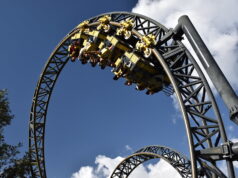
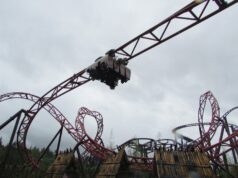
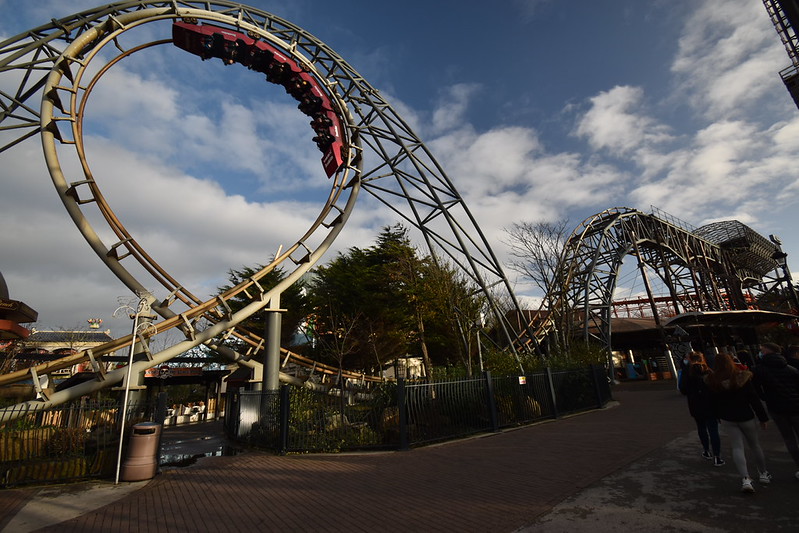
One of the most recognisable elements of any roller coaster is the vertical loop. Attractions like The Smiler at Alton Towers feature multiple inversions that flip riders upside down.
Interestingly, modern loops are not perfect circles. Early roller coasters attempted circular loops, but these produced extremely strong g-forces that were uncomfortable and sometimes dangerous for riders.
Today, engineers use a shape called a clothoid loop. This design starts with a larger radius at the bottom and gradually tightens toward the top of the loop. The result is a smoother experience that keeps forces within safe limits while still delivering the thrill of going upside down.
Even though loops aren’t perfectly circular anymore, π-based calculations are still essential when determining their curvature and overall geometry.

Spirals, Helixes, and Curved Track
Another common roller coaster element is the helix, which is essentially a spiralling turn that wraps around itself. Helixes are designed to maintain speed while delivering strong lateral forces that push riders into their seats.
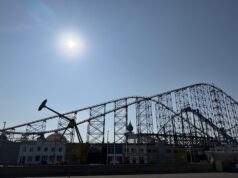
You’ll find helixes on rides like Stealth at Thorpe Park and The Big One at Blackpool Pleasure Beach.
Designing these elements requires engineers to calculate the radius of the turn, the speed of the train, and the forces acting on riders throughout the spiral. Because these shapes rely on circular motion, π once again plays a central role in determining the path of the track.
Banking Turns for Rider Comfort
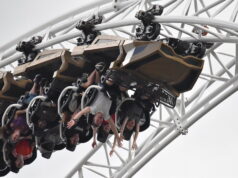
If roller coaster turns were completely flat, riders would experience intense sideways forces. To avoid this, engineers tilt the track into the direction of the turn in a process known as banking.
Banked turns allow the forces generated by the coaster’s speed to push riders downward into their seats rather than sideways across them. This creates a much smoother and more comfortable ride experience.
For example, intense rides such as Nemesis Reborn at Alton Towers feature heavily banked twists that generate powerful yet controlled forces.
To determine the correct banking angle, engineers must carefully balance speed, radius, and gravitational forces. These calculations rely on geometry, trigonometry, and circular motion — all of which involve π in some way.
Modern Roller Coaster Engineering
Today’s roller coasters are designed using powerful computer simulations that analyse every detail of the ride experience. Manufacturers such as Bolliger & Mabillard and Intamin use advanced modelling software to predict how a coaster will perform before it is built.
These simulations track thousands of data points throughout the ride, including speed, g-forces, and structural stress on the track and supports. Engineers can test different layouts and adjust the design until the ride delivers the perfect balance of thrill and safety.
Despite all the advanced technology involved, many of these calculations still rely on the same mathematical constant discovered thousands of years ago: π.
The Hidden Maths Behind Every Thrill
Roller coasters may feel like pure adrenaline, but behind every scream and every drop is a carefully calculated design. Without π, engineers wouldn’t be able to create loops, spirals, curved drops, or smooth turns.
So the next time you ride a coaster at Alton Towers, Thorpe Park, or Blackpool Pleasure Beach, remember that the thrill you’re experiencing is powered by mathematics.
And that makes Pi Day the perfect time to celebrate the hidden maths behind the UK’s most exciting theme park rides.
Follow UK Theme Park Spy on Facebook. Stay up to date with the latest news, ride updates, construction progress, events, and exclusive offers
Be the First to Hear the Latest Theme Park News
From ride announcements to park updates and visitor guides, we cover it all. Add us as a Preferred Source in Google to make sure you never miss our latest stories.
Click here and tick UKThemeParkSpy.com to ensure you see stories from us first in Google Search.