Theme park monorails are more than just a convenient way to travel around an attraction. Gliding above pathways, passing over themed landscapes and offering fantastic views of the park, these transport systems combine clever engineering with impressive technology.
But have you ever wondered how monorails actually work? How do they stay balanced on a single track? What makes them move? And how do they know where to stop?
From their elevated guideways and electric motors to their braking systems and automated controls, there is plenty of fascinating science behind these unusual theme park transport rides.
In this edition of Theme Park Science, we’re exploring how theme park monorails work and the technology that keeps them moving safely around the park.

What Is a Theme Park Monorail?
A monorail is a type of railway transport system that operates using a single main guideway rather than the two parallel rails found on traditional trains.
The word monorail comes from the combination of ‘mono’, meaning one, and ‘rail’.
Most modern theme park monorails use an elevated concrete or steel beam. The train either travels on top of this beam or hangs underneath it, depending on the design.
Many theme parks use monorails to transport visitors between different areas, entrances, hotels, car parks and other attractions. Some are designed primarily as transport systems, while others offer a scenic journey as part of the visitor experience.
One of the best-known examples is the Walt Disney World Monorail System in Florida, which carries visitors between key locations around the resort.
How Do Monorails Stay on a Single Track?
One of the most interesting parts of monorail engineering is how such a large train can travel along a single beam without falling off.
The answer is a carefully designed arrangement of wheels.
Unlike traditional trains, which use steel wheels running on two rails, many modern straddle-beam monorails use rubber tyres that grip the sides and top of a concrete or steel guideway.
These wheels perform different jobs:
- Load-bearing wheels: Support the weight of the train and its passengers.
- Guidance wheels: Keep the vehicle correctly positioned on the guideway.
- Stabilising wheels: Help prevent unwanted movement and maintain stability.
The arrangement allows the train to remain securely supported as it travels around bends and along elevated sections.
The guideway also provides a fixed path, meaning the train cannot simply leave the track in the same way a road vehicle could leave a road.

How Are Theme Park Monorails Powered?
Most modern theme park monorails use electric power rather than traditional diesel engines.
Electric motors provide the force needed to move the train along the guideway.
Depending on the system, electricity may be supplied through an electrified rail or conductor arrangement alongside the guideway, with electrical equipment on the train collecting the power.
The electricity is then used by the train’s motors to turn the drive wheels.
As the wheels rotate against the guideway, the train moves forwards.
Electric propulsion offers several advantages:
- Smooth acceleration and deceleration.
- Reduced noise compared with many conventional engines.
- No exhaust emissions from the train itself.
- Precise control over speed.
- Efficient operation for frequent passenger journeys.
Some systems use linear induction motor technology, which produces movement through electromagnetic forces rather than relying solely on conventional rotary motors and drive wheels.
The exact technology depends on the monorail manufacturer and design.
How Do Monorails Navigate Around Corners?
Although monorails often travel along straight elevated sections, they also need to navigate bends, curves and changes in direction.
This is achieved through carefully engineered guideway sections.
The track is designed with gradual curves that allow the train to change direction without making sudden movements.
The train’s wheel assemblies follow the shape of the guideway, keeping it aligned throughout the journey.
Engineers must consider several factors when designing these curves, including:
- The speed of the train.
- The radius of the bend.
- Passenger comfort.
- The weight of the vehicle.
- The forces acting on the train.
The guideway must also be designed to support the train’s weight and the additional forces created as it moves around corners.
This is particularly important for elevated monorails, where the supporting structures must safely carry the train above the ground.
How Do Monorails Stop at Stations?
Monorails need to be able to slow down and stop at specific locations without causing uncomfortable movements for passengers.
To achieve this, they use sophisticated braking systems controlled by onboard computers and monitoring equipment.
Many modern systems use regenerative braking. This allows the electric motors to act as generators when the train slows down, converting some of its movement energy back into electrical energy.
Other braking systems may include mechanical brakes, which provide additional stopping power and help secure the train when stationary.
The train’s speed and position are monitored throughout its journey, helping the control system manage when it needs to slow down and stop.
At stations, the train must also line up accurately with the passenger platforms so visitors can board and leave safely.
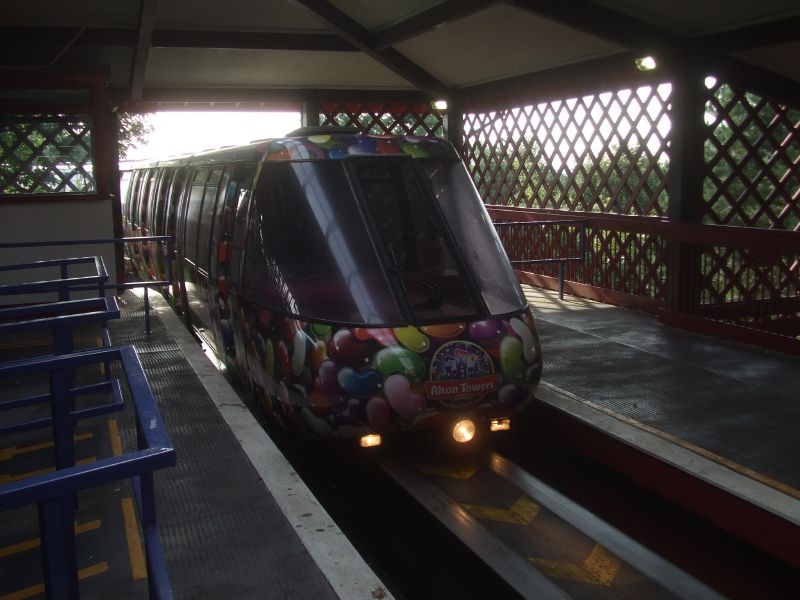
How Are Theme Park Monorails Controlled?
Modern monorails rely on computerised control systems to manage their movements.
These systems help monitor the train’s speed, position, braking and other important operating conditions.
Depending on the system, some monorails are driven manually by an operator, while others use automated or computer-assisted operation.
Control systems can monitor:
- Train speed and acceleration.
- The position of the train along the guideway.
- Braking performance.
- Door operation.
- Electrical power systems.
- Potential faults or unusual operating conditions.
If the system detects a problem, it can trigger warnings or safety responses, including bringing the train to a controlled stop.
Operators and control teams also play an important role in monitoring the wider transport network and responding to operational issues.
Why Are Theme Park Monorails Built Above the Ground?
One of the biggest advantages of a monorail is its ability to travel above the ground.
Elevated guideways allow theme parks to transport visitors without taking up large amounts of space at ground level.
This is particularly useful in busy parks where pathways, attractions, landscaping and entertainment areas already occupy much of the available space.
Building monorails above the ground can provide several benefits:
- Less ground-level disruption: The guideway can pass over pathways and other park areas.
- Better views: Passengers can enjoy views of the park during their journey.
- Improved visitor movement: Guests can travel between different areas without walking the entire distance.
- Efficient use of space: The system can operate above existing infrastructure.
However, elevated monorails require substantial engineering. Supporting columns, foundations and guideways must be designed to withstand the weight of the trains, passengers, wind and other forces.
What Happens If a Monorail Breaks Down?
Like any transport system, monorails can occasionally experience technical problems.
These could involve electrical equipment, motors, sensors, braking systems or other mechanical components.
If a fault occurs, the control system and operators can respond by slowing or stopping the train.
Because monorails often operate on elevated guideways, breakdown procedures must be carefully planned.
Depending on the location and circumstances, passengers may be able to remain onboard until the train can move again, or specially designed evacuation procedures may be required.
Theme parks and monorail operators have procedures for dealing with these situations, with passenger safety remaining the priority.
Are All Theme Park Monorails the Same?
No. Although they share the same basic concept of travelling along a single guideway, monorails can differ considerably in their design and technology.
Some use rubber tyres running along the top and sides of a concrete beam, while others use suspended designs where the passenger vehicle hangs beneath the guideway.
The main differences include:
| Feature | Straddle-beam monorail | Suspended monorail |
|---|---|---|
| Position | Travels on top of the beam | Hangs underneath the beam |
| Support | Wheels grip the guideway | Vehicle supported by overhead structure |
| Appearance | Train sits around the beam | Train hangs below the track |
| Typical use | Passenger transport | Passenger transport |
Both designs provide an alternative to traditional railway systems, although straddle-beam monorails are particularly recognisable at theme parks.
Fascinating Theme Park Monorail Facts
Here are some interesting facts about these unusual transport rides:
- Monorails use a single main guideway rather than two conventional railway rails.
- Many modern monorails use rubber tyres instead of traditional steel railway wheels.
- Electric motors allow monorails to accelerate smoothly and operate with relatively little noise.
- Some monorail systems use regenerative braking to recover energy during deceleration.
- Elevated guideways allow monorails to travel above pedestrian areas and other park infrastructure.
- Monorails can be designed to travel around tight curves, depending on their engineering and operating requirements.
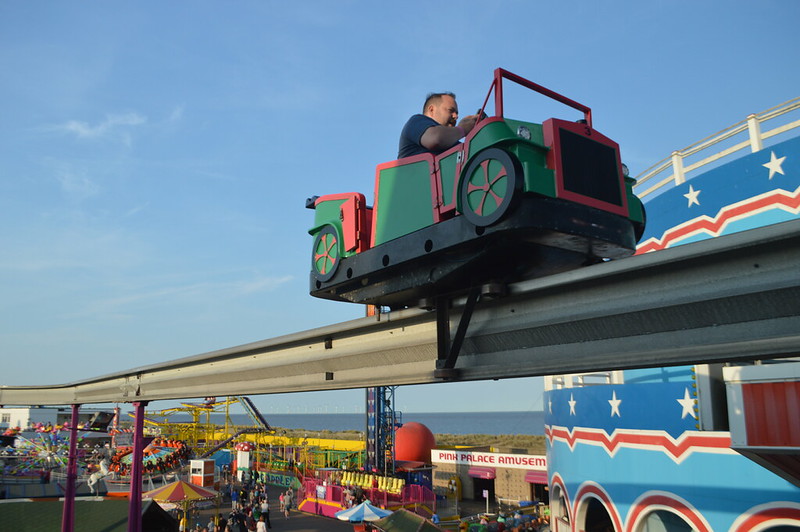
- Not every monorail is a transport system. Some are attractions in their own right, offering scenic journeys around theme parks.
The Engineering Behind Theme Park Monorails
Theme park monorails might look like simple trains travelling along elevated tracks, but there is a lot of clever engineering happening behind the scenes.
From the wheels that keep them balanced on a single guideway to the electric motors that power their journeys, every part of the system has an important job.
Computerised controls, braking technology and carefully engineered structures all help these transport systems move visitors around theme parks.
The next time you see a monorail gliding above a theme park, take a moment to appreciate the technology that makes it possible.
After all, sometimes the journey between attractions can be just as interesting as the rides themselves!
Follow UK Theme Park Spy on Facebook. Stay up to date with the latest news, ride updates, construction progress, events, and exclusive offers
Be the First to Hear the Latest Theme Park News
From ride announcements to park updates and visitor guides, we cover it all. Add us as a Preferred Source in Google to make sure you never miss our latest stories.
Click here and tick UKThemeParkSpy.com to ensure you see stories from us first in Google Search.