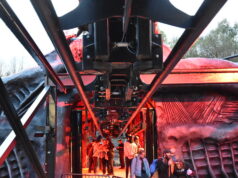
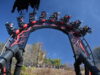
From powerful electric motors to hydraulic systems, discover the science and engineering that send rollercoaster trains accelerating from a standing start to incredible speeds in just a few seconds.
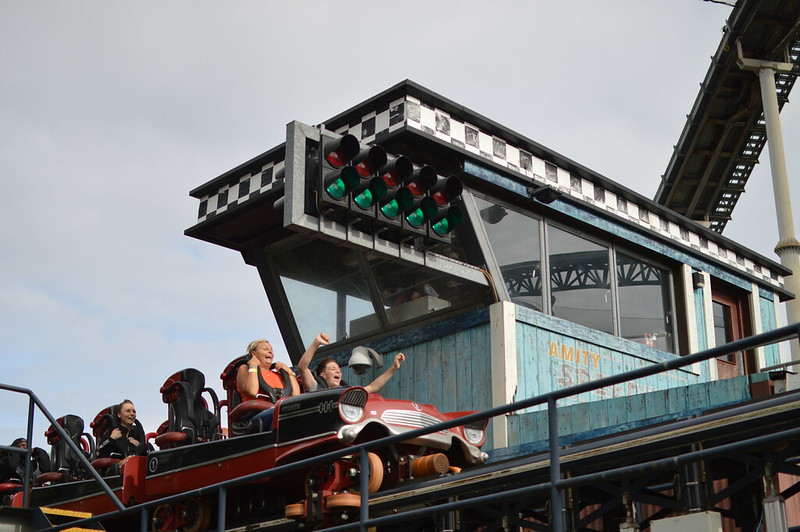
Imagine sitting in a rollercoaster train, waiting for the countdown to finish. Suddenly, there is a powerful surge, the scenery becomes a blur and, before you have time to react, you are travelling at 60 mph.
But how do rollercoasters accelerate so quickly without a traditional lift hill or a long downhill drop?
The answer lies in launch technology. Modern launch rollercoasters use sophisticated engineering systems to transfer energy into a train, accelerating it along the track in a matter of seconds. Different parks use different methods, from electromagnetic motors to powerful hydraulic machinery and compressed air.
Let’s explore the science behind these incredible attractions.
What Is a Rollercoaster Launch?
A launch coaster is a rollercoaster that uses a mechanical or electrical system to accelerate its train rapidly along the track, rather than relying entirely on gravity from a lift hill.
Traditional rollercoasters are usually pulled up a lift hill by a chain, cable or other lifting mechanism. Once the train reaches the top, gravity takes over, converting its stored gravitational potential energy into movement as it descends.
A launch coaster takes a different approach. It uses an external power source to accelerate the train directly, allowing designers to create high-speed experiences without needing a tall lift hill at the beginning.
Some launches take place on a straight section of track, while others send trains through tunnels, into inversions or towards steep hills.
The key scientific principle is acceleration: how quickly an object’s velocity changes over time.
1. Linear Motors: Using Magnetism to Push a Train
One of the most fascinating launch technologies uses electromagnetism to accelerate a rollercoaster train.
Linear motor systems can use either linear induction motors (LIMs) or linear synchronous motors (LSMs). Both use magnetic fields to generate force, but they operate differently.
How does a linear induction motor work?
A linear induction motor can be thought of as an electric motor that has been cut open and laid flat along the track.
Instead of spinning a shaft, it produces a travelling magnetic field along a straight section of the ride.
Here’s how the process works:
- Electricity is supplied to the motor: Electrical power is delivered to stationary motor components installed along the launch track.
- A magnetic field is created: The electrical current produces a magnetic field that travels along the motor.
- The field interacts with the train: Conductive components attached to the train respond to the changing magnetic field, generating forces that propel it forwards.
- The train accelerates: The motor applies force along the launch section, increasing the train’s speed.
The result is a powerful launch without the need for a conventional chain lift or a physical propulsion cable.
What about linear synchronous motors?
Linear synchronous motors also use travelling magnetic fields, but the train’s magnetic field is synchronised with the motor’s moving field.
Depending on the design, permanent magnets or electromagnets on the train interact with the track’s magnetic system. This creates a controlled propulsive force.
LSM technology is particularly useful when engineers need precise control over acceleration, speed and the movement of a train through the launch section.
Which rollercoasters use linear motors?
Stealth at Thorpe Park is a well-known example of a launch coaster using linear induction motor technology. It accelerates riders from 0 to approximately 80 mph in around 1.8 seconds before sending them up a towering top hat element.
This demonstrates how electromagnetic propulsion can deliver an intense burst of acceleration in an incredibly short time.
Linear motors can also be used for other purposes, including controlled braking and moving trains at low speeds, depending on the ride’s design.
2. Hydraulic Launch Systems: Enormous Power in a Short Burst
Before electromagnetic launches became widespread, hydraulic launch systems were famous for delivering some of the most dramatic accelerations in the theme park industry.
These systems use pressurised hydraulic fluid to transfer power from machinery to a launch mechanism.
How does a hydraulic launch work?
A traditional hydraulic launch system may use powerful hydraulic pumps, accumulators, hydraulic motors and a rotating drum connected to a cable system.
The launch sequence generally works like this:
- Energy is stored: Pumps pressurise hydraulic fluid, with accumulators helping store energy ready for the launch.
- The system releases its power: When the launch begins, the stored hydraulic energy drives hydraulic motors.
- A cable system accelerates the train: In a traditional hydraulic launch, the motors rapidly turn a drum that pulls a cable attached to the rollercoaster train.
- The train races forwards: The cable transfers the mechanical force to the train, producing rapid acceleration along the launch track.
This system allows a large amount of power to be delivered over a short period, even when the machinery cannot generate all that power instantaneously from its normal operating state.
Which rollercoasters have used hydraulic launches?
Stealth at Thorpe Park is not a hydraulic launch coaster; it uses linear induction motors. However, hydraulic launches have powered some famous high-speed attractions.
Examples include Rita at Alton Towers and Kingda Ka at Six Flags Great Adventure, which used hydraulic launch systems during their operating lives. Kingda Ka closed in 2024.
Hydraulic launches have been particularly associated with rides that need to reach extremely high speeds in a very short distance.
Why don’t all rollercoasters use hydraulics?
Hydraulic systems can deliver tremendous power, but they also involve substantial mechanical complexity.
They require specialist machinery, hydraulic fluid systems, cables and moving components that need regular inspection and maintenance. Heat management and wear are also important engineering considerations.
For a ride designed around a spectacular, high-speed launch, this technology can be extremely effective. For other attractions, electromagnetic systems may offer a more suitable combination of control, maintenance requirements and operating characteristics.
3. Compressed-Air Launch Systems: Harnessing Pressurised Gas
Compressed air is another way of storing energy that can be released rapidly to produce movement.
In a compressed-air system, a compressor uses energy to squeeze air into a storage vessel. The pressurised air can then be released through valves to drive a mechanism.
As the air expands, it can do mechanical work, helping propel a train or operate a launch mechanism.
How does a compressed-air launch work?
The exact arrangement depends on the ride, but the basic principles are straightforward:
- Air is compressed: A compressor raises the air pressure and stores the energy in a suitable pressure vessel.
- The launch is triggered: Controlled valves release the stored air when the system is ready.
- Pressure creates movement: The expanding air drives a piston, turbine or other mechanical arrangement, depending on the design.
- The mechanism transfers force: The resulting movement accelerates the train or operates a propulsion system.
One important distinction is that compressed air is not the same as a hydraulic launch. Hydraulic systems use pressurised liquid, while pneumatic systems use compressed gas.
Both can store and release energy, but gases are compressible, which affects how they behave under pressure.
Are compressed-air rollercoaster launches common?
Compressed-air propulsion is less commonly associated with major modern high-speed rollercoaster launches than linear motors and hydraulic systems.
Pneumatic technology can still be useful in amusement rides and other attraction mechanisms, including actuators, gates and braking-related equipment. However, the exact use of compressed air to launch a full rollercoaster train depends on the specific ride design.
It is important not to assume that every pneumatic ride mechanism is responsible for accelerating the train itself.
4. The Physics Behind a 0–60 mph Launch
The technology may differ, but the underlying physics is the same: a force must act on the train to increase its speed.
Newton’s second law of motion states that force equals mass multiplied by acceleration:
Force = Mass × Acceleration
This means that accelerating a heavier train at the same rate as a lighter train requires more force.
The train’s acceleration also depends on how quickly it reaches its target speed.
Let’s look at what happens when a coaster accelerates from 0 to 60 mph.
Sixty miles per hour is approximately 26.8 metres per second.
If the train reaches that speed in three seconds, its average acceleration is:
26.8 ÷ 3 = 8.9 metres per second squared
That’s approximately 0.91 times the acceleration caused by Earth’s gravity, often written as 0.91 g.
If the same speed is reached in just two seconds, average acceleration rises to approximately 1.37 g.
These are average figures. The acceleration experienced at any particular moment may be higher or lower, depending on how the launch is controlled.
Why does the launch feel so intense?
When a train accelerates forwards, riders feel a force pushing them back into their seats. This sensation is associated with the train’s forward acceleration.
The shorter the time taken to reach a particular speed, the greater the average acceleration required.
However, speed alone doesn’t tell the whole story. The shape of the acceleration profile, changes in acceleration known as jerk, the direction of the track and the way the seats support riders all influence how a launch feels.
A smooth launch and a sudden, aggressive launch can reach the same top speed but feel very different.
5. How Much Power Does a Launch Coaster Need?
A launch coaster needs to supply enough energy to accelerate its train, overcome rolling resistance and aerodynamic drag, and potentially carry the train into an uphill section.
The kinetic energy of a moving train is calculated using:
Kinetic energy = ½ × mass × speed²
This tells us something important: doubling a train’s speed requires four times as much kinetic energy, assuming its mass stays the same.
The power required depends on how quickly that energy is delivered.
For example, a hypothetical train with a total mass of 10,000 kg travelling at 60 mph has approximately 3.6 million joules of kinetic energy, ignoring losses.
If it reaches that speed in three seconds, the average rate at which kinetic energy increases is roughly 1.2 megawatts. The actual power required from the launch system would be higher because some energy is lost through friction, electrical resistance and other inefficiencies.
This is one reason launch coasters need carefully engineered power systems rather than simply using an ordinary electric motor.
6. Why Do Launch Coasters Sometimes Use More Than One Launch?
Some rollercoasters use several launches during the same ride.
A train might accelerate out of a station, slow down through a sequence of elements and then receive another burst of propulsion later in the course.
Multiple launches can help designers create different sensations and control the train’s speed at specific points.
For example, a second launch might accelerate the train towards a high-speed inversion or provide additional energy for a later section of track.
Not every launch needs to take a train from a complete standstill. Some systems accelerate a train that is already moving, adding energy to its existing motion.
This gives designers more flexibility when creating the ride experience.
7. How Do Engineers Keep Launch Coasters Safe?
Launching a train at high speed requires much more than producing enough power.
Engineers must account for the train’s mass, acceleration, braking distance, track geometry, environmental conditions and the behaviour of the propulsion system.
Modern attractions use control systems and sensors to monitor operating conditions and help ensure the ride follows its designed operating sequence.
Depending on the design, these systems may monitor train position, speed, launch-system status and other important parameters. Interlocks and protective systems help prevent launches when required conditions have not been met.
Braking systems are also crucial. Engineers must ensure the train can be slowed or stopped safely under the operating conditions specified for the ride.
Launch technology is therefore only one part of a much larger engineering system that includes the track, trains, restraints, control systems and maintenance procedures.
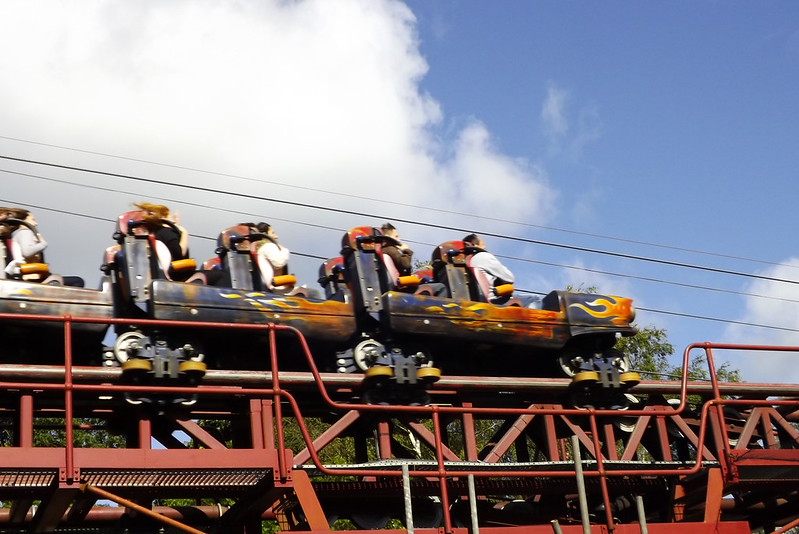
Rollercoasters can accelerate from 0 to 60 mph in seconds because their launch systems deliver a large amount of energy to a train over a very short period.
Linear induction and synchronous motors use electromagnetic forces. Hydraulic launches use pressurised fluid to drive powerful machinery, often connected to a cable system. Compressed-air systems store energy in pressurised gas and release it to operate a propulsion mechanism.
Each approach has different engineering advantages and limitations, but all rely on the same fundamental principles of force, acceleration and energy transfer.
The next time you board a launch coaster, remember that the breathtaking burst of speed is the result of carefully controlled physics and some seriously impressive engineering.
The science behind the thrill is every bit as fascinating as the ride itself.
Follow UK Theme Park Spy on Facebook. Stay up to date with the latest news, ride updates, construction progress, events, and exclusive offers
Be the First to Hear the Latest Theme Park News
From ride announcements to park updates and visitor guides, we cover it all. Add us as a Preferred Source in Google to make sure you never miss our latest stories.
Click here and tick UKThemeParkSpy.com to ensure you see stories from us first in Google Search.