Rotating tower rides are a popular attraction at theme parks and amusement parks around the world. Combining height, movement and spinning, these rides take passengers on an exciting journey upwards while rotating around a central tower.
Unlike traditional observation towers or drop towers, rotating tower rides introduce an additional element of movement, allowing passengers to experience changing views and forces as they climb.
But how do these attractions actually work? What makes the platforms spin, how are they lifted into the air, and what engineering keeps everything operating safely?
Let’s explore the motors, rotating platforms, mechanical systems and physics that make rotating tower rides possible.
What Is a Rotating Tower Ride?
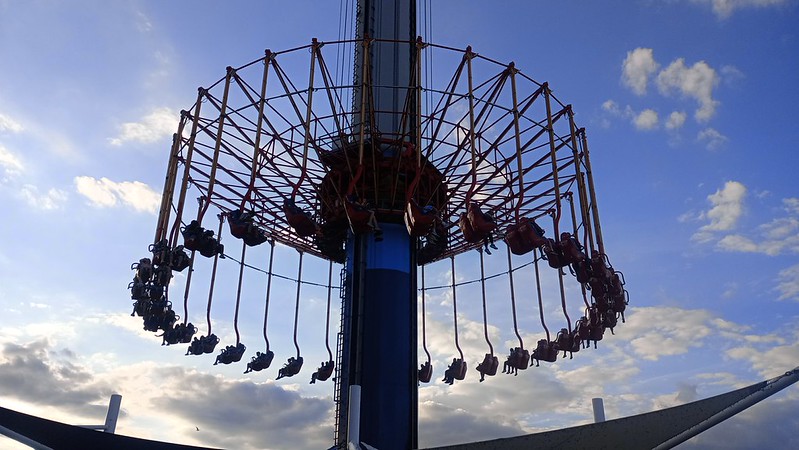
A rotating tower ride is an amusement attraction that carries passengers upwards along a vertical structure while a seating platform or gondola rotates around the tower.
Depending on the ride’s design, passengers may sit facing outwards in individual seats, inside a circular gondola or on a rotating platform that provides panoramic views of the surrounding theme park.
Some attractions rotate continuously throughout the ascent, while others combine spinning with pauses, changes in speed or a controlled descent.
The combination of vertical movement and rotation creates a different experience from a conventional tower ride, where passengers simply travel upwards and downwards.
How Does the Tower Lift Passengers?
At the centre of the attraction is a strong vertical support structure that guides the passenger platform as it travels upwards.
There are several ways engineers can achieve this movement, depending on the ride’s design.
Common lifting systems include:
- Electric motors and drive systems: Motors provide the mechanical power needed to move the passenger platform.
- Cable lifting systems: Strong steel cables can pull the gondola upwards along the tower.
- Hydraulic systems: Pressurised hydraulic fluid can provide the force needed to move lifting mechanisms.
- Mechanical drive systems: Gears, chains or other mechanical components can transfer power to the moving platform.
The tower itself is engineered to support the weight of the passengers, gondola and moving machinery, while also resisting the forces created during operation.
Guide rails or other guiding mechanisms help keep the passenger platform aligned as it travels vertically.
How Do the Rotating Platforms Work?
One of the most interesting parts of these attractions is the rotating platform.
While the gondola moves upwards, a separate mechanical system allows it to spin around the central tower.
This is normally achieved using a combination of electric motors, bearings and mechanical drive components.
The rotating platform is supported by a bearing assembly that allows it to turn smoothly around its central axis. Bearings reduce friction between moving components and help support the considerable loads placed on the rotating structure.
An electric motor provides the power needed to create the spinning movement.
Depending on the design, the motor may drive a gear system, a rotating ring or another mechanical assembly connected to the gondola.
This allows the passenger platform to rotate while the lifting mechanism continues moving it upwards.
Importantly, the lifting and rotating movements can be controlled independently, allowing engineers to adjust the speed and timing of each movement.
What Makes the Ride Spin?
Electric motors are responsible for producing much of the rotational movement found in modern rotating tower attractions.
An electric motor converts electrical energy into mechanical energy, creating the rotational force needed to turn the platform.
The motor’s movement is transferred through a drive system, which may include gears, shafts or other mechanical components.
The speed of rotation can be controlled electronically.
Ride control systems monitor the operation and regulate the motors to ensure the platform follows its programmed movement.
Some attractions maintain a relatively constant rotation speed, while others gradually increase or decrease their spinning movement during the ride.
The result is a combination of vertical travel and rotation that creates the attraction’s distinctive experience.
What Is Centrifugal Force?
Physics plays an important role in how rotating tower rides feel.
As the platform spins, passengers experience forces associated with circular motion.
One commonly used term is centrifugal force. This describes the apparent outward force experienced when observing movement from a rotating reference frame.
In reality, the sensation comes from the inertia of the passenger’s body as the seat and platform continually change direction.
The force required to keep an object moving in a circular path is called centripetal force. It acts towards the centre of rotation.
The amount of centripetal force depends on several factors:
- The mass of the moving object.
- The speed of rotation.
- The distance from the centre of rotation.
The faster the platform spins, the greater the centripetal force required to keep passengers moving in a circular path.
This is one reason why the rotation speed of an amusement ride must be carefully controlled.
Why Does the Ride Feel Different as It Gets Higher?
As passengers travel upwards, their view of the surrounding park gradually changes.
However, height alone does not necessarily increase the spinning forces they experience.
The sensation of rotation depends mainly on the speed of the platform and the distance passengers are positioned from its centre.
Passengers sitting further away from the centre of rotation travel around a larger circular path with every revolution.
If the platform maintains the same rotational speed, those further out will experience a greater sideways acceleration.
The combination of height, movement and changing scenery can make the experience feel increasingly dramatic as the gondola climbs.
Depending on the ride’s design, passengers may also experience changes in acceleration as the platform starts, stops or adjusts its speed.
How Do Engineers Keep Rotating Tower Rides Safe?
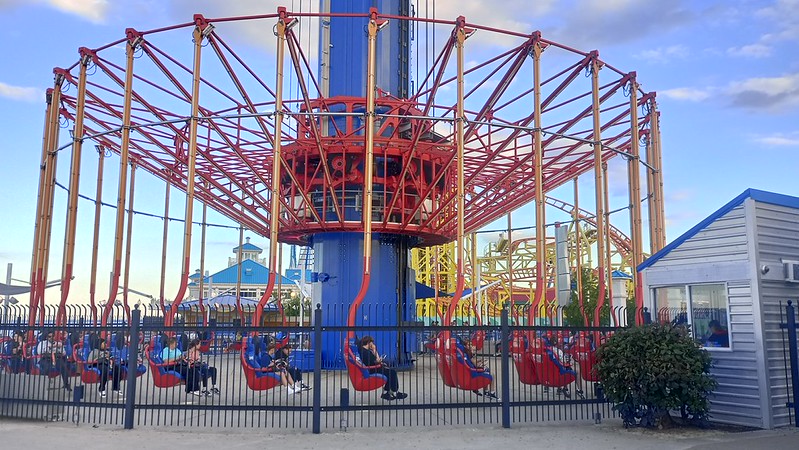
Rotating tower rides involve heavy moving structures, electrical motors and significant mechanical forces.
Safety is therefore built into the attraction’s design from the beginning.
Several systems work together to keep the ride operating within its intended limits.
Structural engineering
The central tower, supporting framework and rotating platform must be designed to withstand the loads created by passengers, machinery and movement.
Braking systems
Braking mechanisms help control the movement of the gondola and rotating platform. Emergency braking systems are also incorporated where required by the ride’s design.
Sensors and monitoring
Sensors can monitor the position, speed and movement of different ride components. This information is sent to the control system.
Passenger restraints
Seats, harnesses, lap bars or other restraint systems keep passengers securely positioned throughout the ride.
Safety interlocks
Interlocks prevent certain movements from taking place unless specific safety conditions have been met. For example, the ride may be prevented from operating if passenger restraints are not correctly secured.
Modern amusement attractions also undergo inspections, testing and planned maintenance to help identify mechanical wear and potential problems.
How Are Rotating Tower Rides Controlled?
Behind the scenes, a sophisticated control system coordinates the different movements.
Programmable controllers receive information from sensors around the attraction and manage the operation of motors, brakes and other mechanical systems.
The system follows a programmed operating sequence, controlling when the gondola rises, how quickly it rotates and when it begins its descent.
Operators also have control stations that allow them to monitor the attraction and respond to warnings or faults.
If a sensor detects an issue or a safety condition is not met, the control system can prevent the ride from continuing its normal operating sequence.
This coordination is essential because the lifting and rotating systems must work together smoothly.
What Is the Difference Between a Rotating Tower Ride and a Traditional Drop Tower?
Although they may look similar, rotating tower rides and traditional drop towers offer different experiences.
A traditional drop tower usually lifts passengers vertically before carrying out a controlled or free-fall-style descent.
A rotating tower ride adds a spinning movement, allowing passengers to rotate around the central structure as they travel upwards or downwards.
Some attractions combine both concepts, using rotation alongside a dramatic drop or changes in vertical movement.
The main difference is the additional rotational system, which introduces another layer of mechanical engineering and physics.
The Engineering Behind the Experience
Rotating tower rides may look relatively simple from the outside, but their operation involves several sophisticated engineering systems working together.
Electric motors generate the movement, mechanical drive systems transfer power, bearings allow platforms to rotate and control systems coordinate the entire attraction.
At the same time, structural engineering ensures the tower can support the forces created during operation, while sensors and safety systems monitor the ride.
The next time you see a rotating tower attraction at a theme park, remember that there is much more happening behind the scenes than passengers simply travelling upwards.
It is a fascinating combination of engineering, physics and amusement ride technology!
We'd love to hear your thoughts!
Join the conversation by leaving a comment on our Facebook page and let us know what you think. We love hearing your opinions!
Be the First to Hear the Latest Theme Park News
From ride announcements to park updates and visitor guides, we cover it all. Add us as a Preferred Source in Google to make sure you never miss our latest stories.
Click here and tick UKThemeParkSpy.com to ensure you see stories from us first in Google Search.