Rollercoasters are famous for their incredible speeds, towering drops and thrilling inversions, but have you ever wondered how much the actual rollercoaster train weighs?
With trains carrying dozens of passengers around twisting tracks, climbing enormous hills and travelling through high-speed turns, rollercoaster trains are much heavier than they might first appear.
The weight of a rollercoaster train depends on its design, size, materials and the number of cars it contains. Some smaller coaster trains weigh just a few tonnes, while larger trains can weigh considerably more.
So, what makes up the weight of a rollercoaster train, and how do engineers make sure these enormous vehicles can travel safely around the track?
How Much Does a Rollercoaster Train Weigh?
There is no single answer because rollercoaster trains come in many different shapes and sizes.
A small family rollercoaster train might weigh a few tonnes, while a large steel rollercoaster train carrying several dozen passengers can weigh considerably more.
As a general illustration, a modern rollercoaster train could weigh somewhere in the region of 5–15 tonnes, although individual designs can fall outside this range.
The total weight is influenced by several factors, including:
- Number of cars: Longer trains generally require more materials and weigh more.
- Passenger capacity: More seats, restraints and supporting structures add weight.
- Construction materials: Steel, aluminium and other engineered materials all contribute to the overall mass.
- Ride design: Trains designed for inversions, high speeds or unusual movements may require different engineering.
- Wheels and undercarriage: The wheel assemblies, axles and supporting structures are essential parts of the train.
It is important to remember that the weight of an empty train is different from its operating weight once passengers are on board.
What Makes a Rollercoaster Train So Heavy?
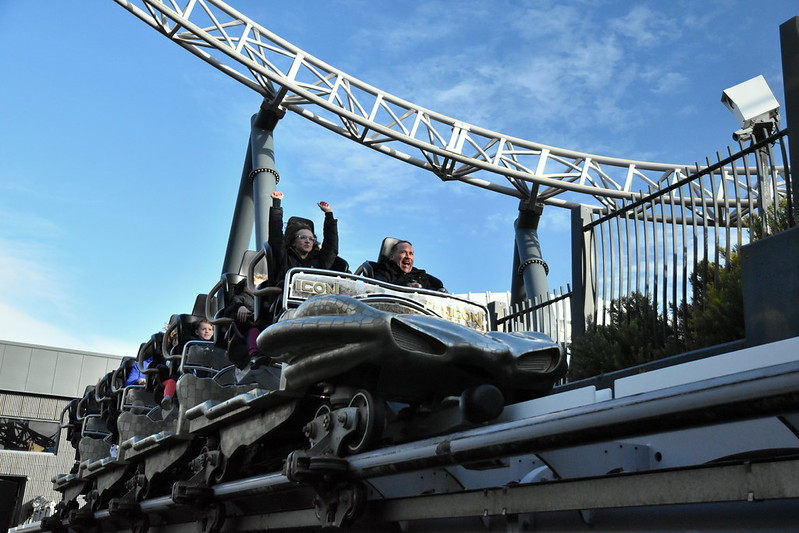
A rollercoaster train might look relatively simple from the outside, but it contains numerous components that have been carefully engineered to withstand enormous forces.
The main parts include:
1. The chassis
The chassis is the main structural framework that supports the train. It needs to be strong enough to carry passengers while handling the forces generated as the train travels around the track.
2. The seats and restraints
Every passenger seat has a restraint system designed to keep riders securely in place. Depending on the coaster, these might include lap bars, shoulder restraints or other safety systems.
3. The wheels
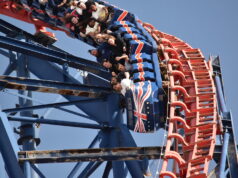
Rollercoaster trains use specialised wheel assemblies to guide them along the track. Many steel rollercoasters use three sets of wheels:
- Running wheels, which support the train on top of the track.
- Side friction wheels, which help guide the train around bends.
- Up-stop wheels, which prevent the train from lifting away from the track.
4. The braking and control systems
Rollercoaster trains also have components that allow the ride’s braking and control systems to operate. These vary depending on the manufacturer and ride design.
All these components contribute to the overall weight of the train.
How Much Does a Rollercoaster Train Weigh With Passengers?
The weight increases significantly once passengers climb aboard.
Imagine a rollercoaster train carrying 24 passengers. If each passenger has an average mass of 75kg, the passengers alone would add:
24 × 75kg = 1,800kg.
That is an additional 1.8 tonnes!
If the empty train weighed 8 tonnes, its total operating mass with those passengers would be approximately 9.8 tonnes.
This is a simplified example, but it demonstrates why engineers must consider both the empty train and its fully loaded weight when designing a rollercoaster.

Does a Heavier Rollercoaster Train Go Faster?
Not necessarily!
You might assume that a heavier rollercoaster train would travel faster because it has more weight behind it, but the science is a little more complicated.
Gravity is what accelerates a rollercoaster down a hill. Ignoring friction and air resistance, the acceleration due to gravity is the same regardless of the train’s mass.
However, a heavier train has greater momentum at the same speed. This means it can be more difficult to slow down or change its movement.
In real-world conditions, factors such as air resistance, wheel friction, track design and the distribution of passengers all influence how a rollercoaster behaves.
Engineers carefully calculate these factors to ensure the train performs as intended.
How Do Rollercoaster Tracks Support All That Weight?
Rollercoaster tracks are specifically engineered to support the weight of the train, passengers and the additional forces created during the ride.
It is not just the weight of the train sitting on the track that matters.
When a rollercoaster travels through a steep drop, a banked turn or an inversion, the forces acting on the train can change dramatically.
Engineers calculate these forces when designing the track, supports and foundations.
The structure must be capable of handling the train’s weight alongside the dynamic forces produced during operation.
This is particularly important on large rollercoasters featuring high speeds, steep drops and multiple inversions.
Why Don’t Rollercoaster Trains Just Get Lighter?
You might think manufacturers would simply try to make rollercoaster trains as light as possible.
However, reducing weight is not the only consideration.
Trains must be strong, durable and capable of handling repeated forces throughout thousands of operating cycles.
They also need to accommodate passengers comfortably and include all the necessary safety systems.
Manufacturers therefore have to find the right balance between weight, strength, performance and reliability.
Modern engineering techniques and materials help manufacturers develop trains that are both structurally strong and efficient.
The Science Behind Every Rollercoaster Train
The next time you climb aboard a rollercoaster, remember that you are sitting inside a carefully engineered vehicle that could weigh several tonnes before it even carries a single passenger.
From the wheels and chassis to the seats and restraints, every component contributes to the train’s overall weight and performance.
And while the train might look like it is simply racing around the track, a huge amount of engineering and physics makes every twist, turn and drop possible.
That’s the science behind rollercoaster trains!
We'd love to hear your thoughts!
Join the conversation by leaving a comment on our Facebook page and let us know what you think. We love hearing your opinions!
Be the First to Hear the Latest Theme Park News
From ride announcements to park updates and visitor guides, we cover it all. Add us as a Preferred Source in Google to make sure you never miss our latest stories.
Click here and tick UKThemeParkSpy.com to ensure you see stories from us first in Google Search.